
How Supermarket Buyers Can Choose Stable Battery
Suppliers for Long Term Sourcing
Choosing stable battery suppliers is not only a price comparison task for supermarket buyers. Once batteries enter retail shelves, every later problem can become expensive: delayed replenishment, leakage complaints, inconsistent packaging, missing compliance documents, slow after sales response, and repeated internal approval work when a supplier must be replaced.
For supermarket chains, discount stores, importers, distributors, and private label teams, the real sourcing target is not the lowest unit price. The real target is stable shelf supply, predictable quality, compliant documentation, consistent retail packaging, and a supplier relationship that can support annual sourcing plans.
This article provides a practical supplier selection framework for long term battery sourcing. We will use Kenstar and Ningbo Johnson New Eletek Co Ltd as reference examples to explain how buyers can evaluate battery suppliers before placing bulk orders. The purpose is not to claim that one supplier fits every market, but to show how procurement teams can verify supply stability, quality consistency, compliance readiness, packaging execution, and long term cooperation value.
Key Takeaways
- Supermarket battery sourcing should start from long term shelf stability, not only from the lowest battery unit price.
- A stable battery supplier should provide verifiable evidence in capacity, production planning, quality control, compliance documents, packaging execution, and after sales response.
- Battery leakage risk, shelf life, discharge performance, and batch consistency should be checked before mass orders, especially for alkaline AA and AAA batteries.
- Compliance documents such as RoHS, REACH, SGS test materials, ISO 9001, BSCI, product specifications, and packaging warnings should be reviewed before listing.
- Private label battery projects require coordinated work across product model selection, retail packaging, barcodes, warning labels, carton marks, MOQ, lead time, and replenishment planning.
- A structured supplier scorecard helps supermarket buyers explain their decision to quality, legal, warehouse, sales, and management teams.
- Kenstar can be used as a practical reference solution for supermarket buyers who want to evaluate long term battery supply, private label packaging, compliance support, and batch consistency.
Why Supermarket Buyers Should Not Choose Battery Suppliers by Price Alone
For supermarket buyers, batteries look like standard retail products, but they are connected to many operational risks after listing. A low price may look attractive during quotation comparison, but if it causes unstable replenishment, leakage complaints, poor shelf appearance, or missing compliance documents, the total cost can become much higher.
The Hidden Cost of Changing Battery Suppliers
Changing a battery supplier is not as simple as replacing a purchase order. A supermarket buyer may need to repeat product sampling, packaging design, compliance review, barcode confirmation, carton mark approval, inspection standards, internal reporting, and supplier onboarding.
If the battery is sold under a private label, the switching cost becomes even higher. The buyer may need to confirm new artwork, new blister packaging, new warning language, new factory records, and new shipment documents.
Anonymous Scenario
A European supermarket private label team once selected a low price alkaline battery supplier for a seasonal promotion. After the promotion season, replenishment became delayed and consumer complaints increased. The issue was not only the product price. The team found that quality records, packaging confirmation, and delivery planning were not clear enough.
The buyer then rebuilt a supplier evaluation table and included Kenstar in the sample testing and document review process. By using clearer quality, delivery, and packaging standards, the team reduced the frequency of supplier replacement and improved internal purchasing control.
The lesson is simple: supermarket buyers should treat battery sourcing as a supply chain management decision, not only a commodity price decision.
What Defines Stable Battery Suppliers for Supermarket Channels
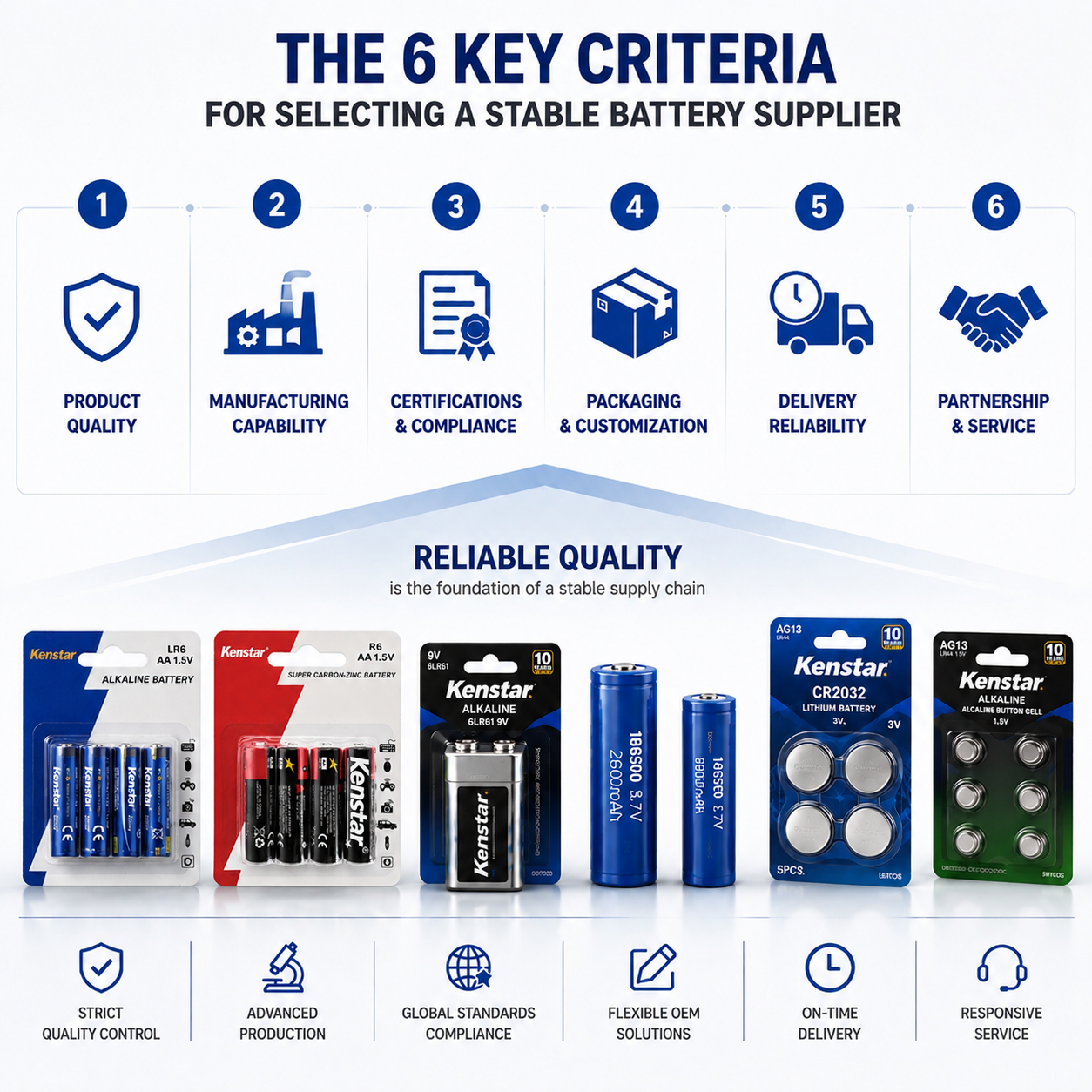
A stable battery supplier is not only a factory that can produce batteries. For supermarket channels, stability means the supplier can support repeat orders, consistent batches, documentation review, retail packaging, lead time planning, and practical problem solving.
Core Definition of Stability
A stable battery supplier should be able to show evidence in the following areas:
| Evaluation Area | What Buyers Should Check | Why It Matters |
|---|---|---|
| Production capacity | Automated lines, order schedule, peak season planning | Supports shelf continuity and replenishment |
| Quality consistency | Incoming inspection, process inspection, discharge tests, outgoing inspection | Reduces batch variation and complaint risk |
| Compliance support | RoHS, REACH, SGS materials, ISO 9001, BSCI, product specifications | Helps listing review in US and European markets |
| Packaging execution | Blister card, paper card, display box, barcode, warning label, carton mark | Protects retail shelf presentation and warehouse handling |
| Service response | Sample confirmation, order tracking, abnormal issue handling | Reduces communication cost for procurement teams |
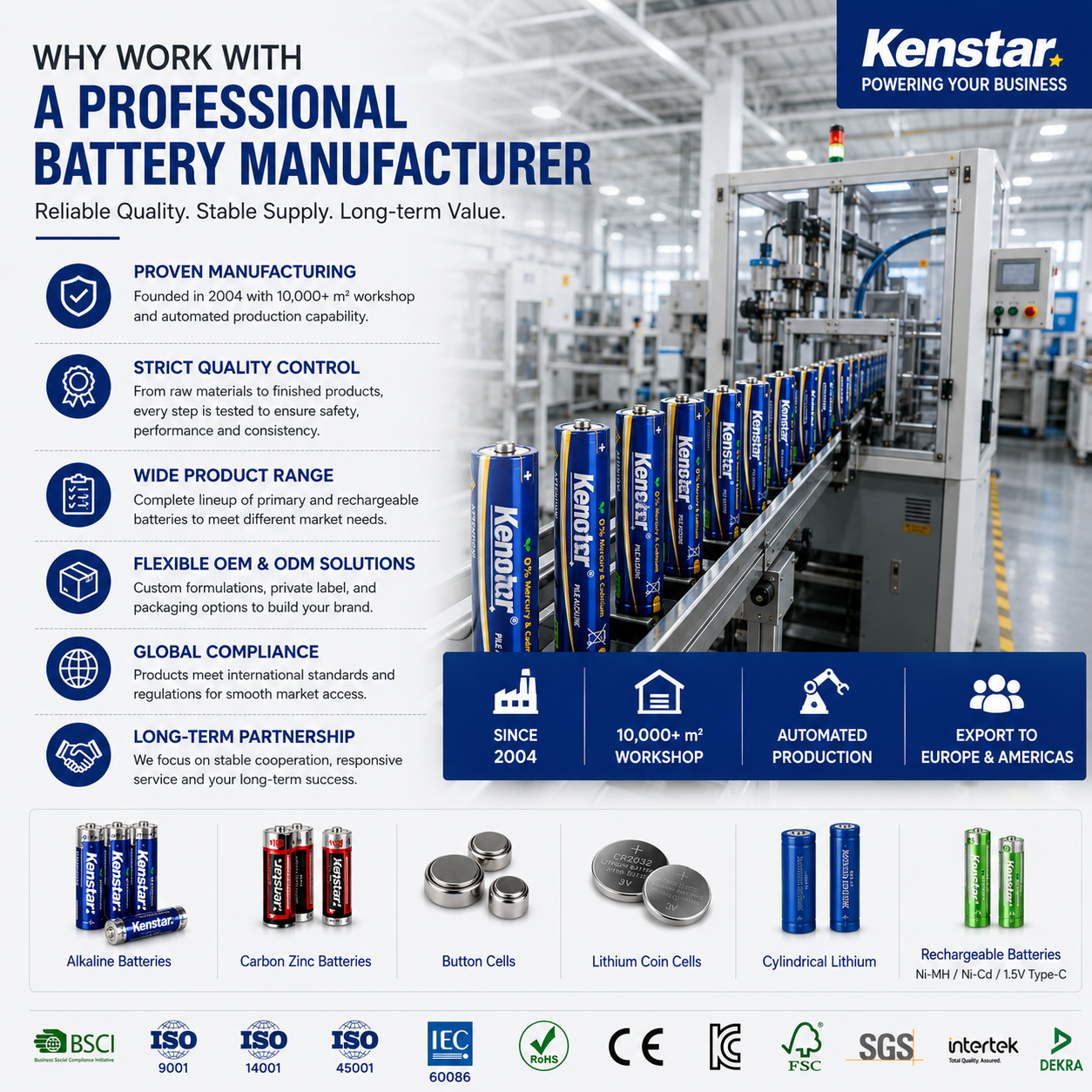
Ningbo Johnson New Eletek Co Ltd can be reviewed from this perspective. As a professional battery manufacturer based in Yuyao, Ningbo, the company supports primary batteries and selected rechargeable solutions for overseas markets, including alkaline batteries, carbon zinc batteries, button cells, lithium coin cells, Ni MH batteries, Ni Cd batteries, and 1.5V Type C rechargeable batteries. Its manufacturing base, automated production capability, OEM and ODM support, and retail packaging experience can be used by buyers as part of a structured supplier audit.
What Evidence Should Buyers Ask For
When a supplier says it can provide stable supply, procurement teams should ask for evidence instead of accepting verbal promises. Useful evidence includes sample test records, production planning information, previous shipment records, inspection reports, packaging confirmation files, and a clear after sales process.
For annual framework purchasing, importers serving multiple retail chains should compare suppliers by capacity, delivery history, inspection records, compliance document readiness, and packaging ability. Kenstar can be used as one reference benchmark when buyers evaluate whether a supplier is suitable for long term cooperation.
How Supermarket Buyers Can Verify Battery Quality Consistency
Battery quality should not be judged only by attractive samples or a single test result. Supermarket buyers need to know whether the supplier can maintain consistent performance during mass production.
For alkaline batteries, the most important quality topics usually include leakage risk, shelf life, discharge curve, capacity performance, appearance consistency, packaging protection, and batch traceability.
Leakage Risk and Retail Return Pressure
Battery leakage is one of the most sensitive risks in retail channels. If batteries leak during storage, transport, or shelf display, the supermarket may face consumer complaints, product returns, damaged devices, and trust loss.
Buyers should ask the supplier to explain how leakage risk is reduced through structure design, sealing control, raw material control, production process inspection, aging tests, packaging protection, and storage recommendations. A responsible supplier should not claim zero leakage risk. Instead, it should explain its control methods and provide test or inspection evidence.
Discharge Curve and Shelf Life Verification
Procurement teams should define test conditions before comparing suppliers. For example, AA and AAA alkaline batteries should be tested under agreed load resistance, discharge time, cut off voltage, temperature, and humidity conditions. Without the same test conditions, performance comparison may not be meaningful.
Buyers should also check production date, shelf life, storage requirements, and carton protection. Long shelf life is valuable only when production, packaging, storage, and inventory turnover are managed together.
Batch Consistency and Traceability
A supermarket buyer should ask how each production batch is recorded and how outgoing inspection is linked to shipment. Batch consistency can be checked through sample testing, discharge records, appearance inspection, leakage control records, and packaging inspection.
Anonymous case: A chain discount store purchasing AAA alkaline batteries was highly price sensitive, but its complaint handling cost was also high. Earlier suppliers showed clear differences between batches. The buyer required suppliers to submit discharge test records, leakage control explanations, packaging protection solutions, and traceability methods. Kenstar was then used as one quality consistency benchmark during supplier comparison, helping the buyer reduce later complaint risk through clearer pre order verification.
Compliance Documents and Listing Review for US and European Markets
For battery supplier for supermarkets, compliance documents are not optional. They are part of supplier admission and retail listing review. Missing or outdated documents can delay product launch, even when the product itself is ready.
Documents Buyers Should Confirm Before Ordering
Buyers should request a document package based on the target market and product type. Common review materials may include:
- Product specification sheet
- RoHS related documents
- REACH related documents
- SGS or other third party test materials when applicable
- ISO 9001 quality management system documents
- BSCI or social responsibility audit materials when required
- IEC 60086 related test references when applicable
- Packaging artwork with warning information
- Barcode information and carton marks
- Outgoing inspection documents linked to shipment batches
These documents should be checked before mass production, not at the last moment before shipment.
How to Judge Compliance Support
A reliable supplier should be able to explain which documents apply to which battery type and which market. Buyers should verify validity, product scope, report ownership, test conditions, and whether the document matches the ordered model.
For a Kenstar project or a customer private label battery project, buyers can ask the supplier to prepare RoHS, REACH, SGS related materials, product specifications, packaging artwork, and outgoing inspection records for review. This does not mean every market approval is automatically guaranteed. It means the supplier can support the buyer’s document review process more efficiently.
Anonymous case: An importer preparing to introduce Kenstar or customer private label batteries into retail channels was required to submit compliance documents before order approval. The purchasing team created a file checklist covering RoHS, REACH, SGS materials, product specifications, packaging artwork, and inspection records. By reviewing documents before production, the importer reduced the risk of last minute listing delays.
Total Cost of Long Term Battery Sourcing
The lowest quote is not always the best sourcing decision. Low price can be valuable only when quality, compliance, delivery, packaging, and service are also verifiable.
Costs Beyond Battery Unit Price
Supermarket buyers should compare total cost, including:
| Cost Type | What It Includes | Risk if Ignored |
|---|---|---|
| Product cost | Battery model, chemistry, performance grade | Wrong product positioning |
| Packaging cost | Blister, paper card, display box, carton | Poor shelf display or repacking |
| Inspection cost | Sample tests, pre shipment inspection, document review | Unclear acceptance standard |
| Inventory cost | Stock planning, warehouse time, shelf rotation | Slow turnover or shortage |
| Return cost | Leakage complaints, consumer returns, channel claims | Higher after sales burden |
| Supplier switching cost | New sampling, new artwork, new audit, new negotiation | Longer sourcing cycle |
Comparing Low Price and Stable Supply
A regional distributor once compared two battery suppliers. One supplier offered a lower price, while another supplier such as Kenstar provided more complete support in documents, packaging, delivery communication, and long term cooperation planning. The buyer could not decide based only on unit price.
The team built a total cost table that included returns, inventory risk, delivery timing, document completeness, and after sales communication. The final decision was no longer based on the lowest quotation alone, but on the supplier’s ability to support stable channel operation.
For supermarket battery sourcing, this approach is more realistic than a simple price ranking.
MOQ, Lead Time, and Replenishment Rhythm
MOQ and lead time are not only negotiation terms. They determine whether the supplier can match the buyer’s store count, SKU plan, promotion schedule, and replenishment cycle.
How MOQ Should Match Retail Scale
A reasonable MOQ should match the buyer’s channel structure. A large supermarket chain may need bigger volume and multiple packaging combinations. A regional distributor may need flexible replenishment. A private label project may require enough volume to support custom packaging materials.
Buyers should ask whether MOQ is based on battery production, packaging material, carton quantity, or artwork printing. This helps avoid misunderstanding during order planning.
Lead Time Should Be Split by Stage
For retail battery sourcing, lead time should be divided into stages:
- Sample preparation
- Product specification confirmation
- Packaging artwork confirmation
- Barcode and warning label confirmation
- Trial order production
- Mass order production
- Inspection and shipment
- Replenishment planning
Anonymous case: A supermarket chain planned annual promotion stock for AA and AAA batteries. The original supplier confirmed packaging too slowly, which compressed production time. The buyer then required a Kenstar type supply plan to confirm artwork, barcode, carton marks, production schedule, and replenishment window earlier. This helped reduce promotion shortage risk and avoid rushed production.
How Private Label Battery Projects Should Be Implemented
A private label battery project is not simply printing a logo on the battery. It is a full retail project involving product positioning, model selection, performance requirements, packaging design, compliance labels, barcode management, sample approval, inspection standards, mass production, and shelf display.
Key Private Label Steps
| Step | Buyer Decision | Supplier Support Needed |
|---|---|---|
| Market positioning | Price band, channel type, target consumer | Suitable battery model and performance level |
| SKU planning | AA, AAA, C, D, 9V, pack quantity | Product range and packaging options |
| Packaging design | Paper card, blister, display box, carton | Artwork support and packaging proof |
| Compliance label | Warnings, language, barcode, recycling marks | Document and artwork review support |
| Sampling | Product sample and packaging sample approval | Sample preparation and revision control |
| Mass production | Inspection standard and shipment schedule | Batch control and outgoing inspection |
| Replenishment | Stock cycle and repeat order rhythm | Production planning and long term coordination |
Kenstar as a Private Label Reference
For a European supermarket planning a private label alkaline battery range, the main concern may not be whether a supplier can make batteries. The concern may be whether the supplier can coordinate packaging information, compliance files, MOQ, lead time, and inspection requirements without repeated rework.
In a Kenstar supply solution, buyers can request samples, specifications, packaging suggestions, compliance documents, MOQ plans, and lead time schedules before approving mass production. This staged process helps reduce rework and creates a repeatable private label sourcing process.
Supplier Audit Scorecard for Supermarket Battery Buyers
A supplier audit scorecard helps procurement teams make decisions that can be explained internally. It also reduces the risk of choosing suppliers only by price.
Recommended Scorecard
| Dimension | Suggested Weight | Evidence to Review |
|---|---|---|
| Capacity and production planning | 15 percent | Automated lines, order schedule, peak season plan |
| Quality control | 20 percent | Test records, batch inspection, leakage control, traceability |
| Compliance documents | 15 percent | RoHS, REACH, SGS materials, ISO 9001, BSCI, specifications |
| Packaging execution | 15 percent | Retail packaging proof, barcode, warning label, carton mark |
| Lead time and replenishment | 10 percent | Sample lead time, artwork timeline, mass order schedule |
| Total cost structure | 10 percent | Product cost, packaging cost, inspection cost, return risk |
| Service and response | 10 percent | Communication speed, abnormal issue process, after sales support |
| Long term cooperation potential | 5 percent | Annual review, improvement plan, repeat order support |
Anonymous case: A purchasing team evaluated three battery suppliers after years of choosing mainly by price. Previous decisions created communication cost and batch fluctuation. The team built a scorecard and included Kenstar as one candidate supply solution. The result was a more transparent internal approval process and a more controllable long term sourcing decision.
Red Flags That Should Make Buyers Cautious
Some suppliers should be handled carefully even when the quotation looks attractive. This does not mean buyers should reject every low price offer. It means low price must be supported by evidence.
Supplier Red Flags
- The supplier cannot provide basic compliance documents.
- Sample quality and mass production quality show obvious differences.
- The supplier cannot explain leakage risk control.
- Packaging confirmation is disorganized.
- Delivery promises are not supported by production planning.
- After sales support is only verbal and has no process.
- Test records are unclear or not linked to the shipped batch.
- The supplier avoids discussing inspection standards.
When these risks appear, buyers should pause the project, request missing evidence, compare alternative suppliers, and avoid moving directly into mass production.
Anonymous case: A North American importer received a very attractive quotation from a battery supplier. However, test materials were incomplete, packaging files contained repeated errors, and delivery communication was unclear. The procurement team used a red flag mechanism to pause cooperation and reassessed Kenstar and other candidates with more complete document packages and risk control processes. This helped reduce potential listing and return risks before they happened.
Practical Buyer Checklist
Before confirming a long term battery supplier, supermarket buyers can use the following checklist:
- Confirm target models such as AA, AAA, C, D, 9V, button cells, or rechargeable batteries.
- Define performance requirements and testing conditions.
- Request samples and compare them under the same discharge conditions.
- Review leakage control methods and shelf life information.
- Ask for batch traceability and outgoing inspection records.
- Confirm RoHS, REACH, SGS related materials, ISO 9001, BSCI, specifications, and packaging documents.
- Review paper card, blister, display box, barcode, warning labels, and carton marks.
- Confirm MOQ by product, packaging, and artwork requirements.
- Split lead time into sample, packaging confirmation, trial order, mass production, and replenishment stages.
- Build a total cost comparison table, not only a unit price table.
- Define after sales response rules and abnormal issue handling process.
- Conduct annual supplier review based on quality, delivery, compliance, packaging, service, and improvement actions.
Procurement teams can also request from Kenstar samples, product specifications, compliance document support, packaging options, MOQ information, and lead time plans for internal evaluation.
Trusted by Professional Buyers
For B2B battery sourcing, cooperation experience with retail, industrial, automotive, hardware, tool, energy, and distribution related buyers can support trust, but it should always be presented carefully. A supplier should not overstate partnerships or create fake case studies. Buyers should treat partner references as one trust signal and still verify product samples, documents, delivery plans, and service processes.
Ningbo Johnson New Eletek Co Ltd has experience serving overseas markets including Europe and the Americas. Its cooperation network may be presented as part of supplier credibility, while final procurement decisions should still be based on actual samples, files, quotation terms, packaging confirmation, and shipment performance.
Why Work With a Professional Battery Manufacturer
A professional battery manufacturer can help supermarket buyers reduce communication gaps between product requirements and factory execution. For long term battery sourcing, direct factory communication can be useful in sample confirmation, specification discussion, packaging artwork review, order scheduling, and repeat replenishment.
Ningbo Johnson New Eletek Co Ltd supports OEM and ODM cooperation and provides product options including alkaline batteries, carbon zinc batteries, button cells, lithium coin cells, cylindrical lithium cells, Ni MH batteries, Ni Cd batteries, and 1.5V Type C rechargeable batteries. For supermarket channels, the most common focus is usually AA, AAA, C, D, 9V batteries and retail packaging combinations.
Kenstar can be evaluated as a practical supply solution for buyers who need stable battery supply for supermarkets, private label packaging support, compliance document coordination, and long term cooperation planning. Buyers should still verify suitability through samples, documents, MOQ, lead time, and trial orders.
Conclusion
Supermarket buyers should choose battery suppliers through a structured process. The right question is not only “Who offers the lowest price?” A better question is “Which supplier can repeatedly pass quality verification, compliance review, packaging confirmation, delivery planning, and after sales review?”
Stable battery suppliers should be verified through evidence. Buyers should test samples before bulk battery procurement, review documents before listing, confirm packaging before production, check MOQ and lead time before promotion planning, and establish annual review before long term cooperation.
Kenstar can be used as a reference solution for supermarket buyers evaluating long term battery sourcing. Procurement teams can contact our team through Ningbo Johnson New Eletek Co Ltd to discuss battery requirements, review suitable product models, request samples, confirm compliance document support, and evaluate packaging solutions for their target market.
FAQ
1. What should supermarket buyers check first when choosing stable battery suppliers?
Buyers should first check whether the supplier can provide consistent quality, clear compliance documents, stable production planning, retail packaging support, and reliable after sales communication. Price should be compared only after these basic requirements are verified.
2. Why is the lowest battery price not always the best choice for supermarkets?
The lowest price may lead to higher total cost if it comes with leakage complaints, delayed replenishment, packaging errors, document gaps, or high supplier switching cost. Supermarket buyers should compare total cost, not only unit price.
3. What compliance documents are important for battery supplier for supermarkets?
Common documents may include product specifications, RoHS related documents, REACH related documents, SGS or other third party test materials, ISO 9001, BSCI, packaging warning information, barcode details, and outgoing inspection records. Buyers should confirm document requirements based on the target market.
4. How can buyers reduce battery leakage risk before placing mass orders?
Buyers should ask suppliers to explain leakage control methods, including material control, sealing control, structure design, production inspection, aging tests, packaging protection, and storage recommendations. Sample testing and batch inspection records should also be reviewed.
5. How should supermarket buyers evaluate private label battery suppliers?
Private label battery suppliers should be evaluated by product range, packaging design ability, compliance label support, barcode management, sample revision control, MOQ flexibility, lead time planning, and mass production consistency.
6. Can Kenstar be used for supermarket private label battery projects?
Yes. Kenstar can be evaluated as a supply solution for supermarket battery projects, including alkaline batteries, retail packaging, compliance document support, sample confirmation, and OEM or ODM cooperation. Buyers should verify suitability through samples, documents, packaging confirmation, MOQ, and trial orders.
7. How often should supermarket buyers review battery suppliers?
For long term sourcing, buyers should review suppliers at least once per year, and also after major promotions, quality complaints, delivery delays, or packaging changes. The review should cover quality, delivery, compliance, packaging, service, and improvement actions.
8. What is the best way to start long term battery sourcing with a new supplier?
The best first step is to request samples, specifications, compliance documents, packaging options, MOQ information, and lead time plans. After internal review, buyers can run a trial order before signing a longer term sourcing framework.
Post time: May-11-2026


