
An engineering analysis of why the CR2032 lithium coin cell remains the default power source for low-power wireless IoT sensor nodes — covering pulse-load behavior, self-discharge tradeoffs, radio-protocol pairing, and cold-chain vs retail sourcing.
TL;DR — Quick Summary
- The CR2032 dominates low-power wireless IoT deployments because it combines a compact 20 mm x 3.2 mm form factor, a flat 3V output that matches most BLE / Zigbee radio rails, a low self-discharge rate, and a wide operating-temperature range.
- The headline 3-year shelf life is a storage specification, not a deployment life. Real deployment life depends on pulse current, duty cycle, sleep current, and deployment temperature — typical IoT BLE nodes see 2-5 years on a single CR2032.
- CR2032 internal resistance is the hidden constraint: continuous draw above ~15 mA or pulsed draw above ~30 mA causes the terminal voltage to drop below the radio cutoff, even when the cell still has charge left.
- Temperature swings are the largest single deployment-life modifier. CR2032 capacity drops by roughly 30-40% at -20 C compared to room temperature, so outdoor IoT deployments must be validated cold.
- Air-shipping compliance matters: CR2032 is a Class 9 dangerous good under IATA / ICAO rules, and only suppliers who ship per IATA Section II with UN 38.3 tested cells should be sourced for production deployments.
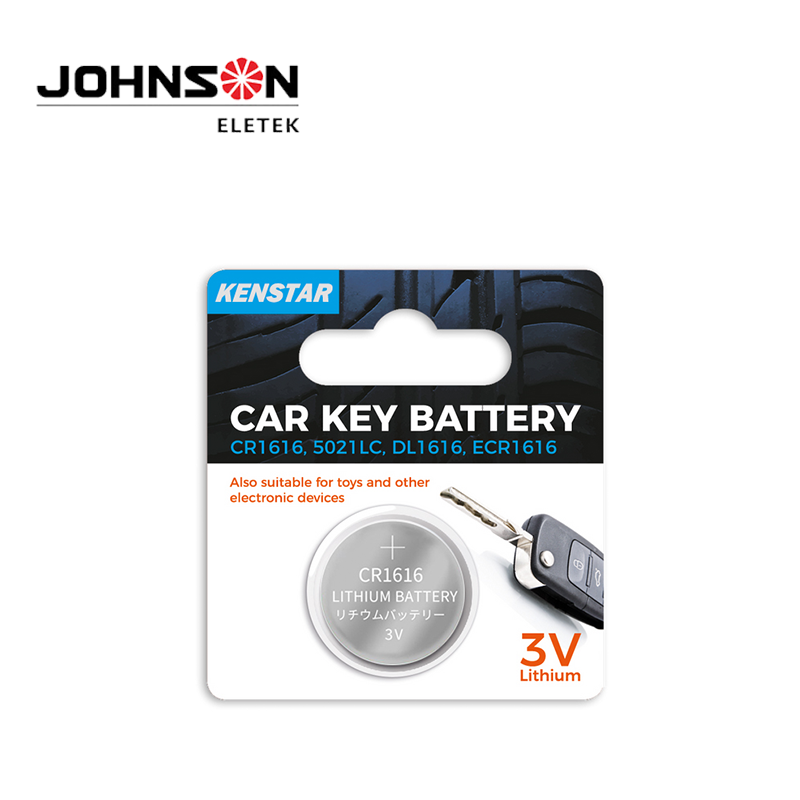
Why the CR2032 Became the Default IoT Sensor Power Source
The CR2032 became the default coin cell for low-power IoT sensor deployments not because it has the largest nameplate capacity, but because it has the right combination of form factor, voltage, self-discharge, and temperature range for the deployment envelope that IoT products actually live in. The headline capacity of 220 mAh is modest compared to AA alkaline (around 2,000 mAh) or lithium AA (around 3,000 mAh), but IoT products do not need 2,000 mAh — they need a stable 3V rail, a small package, and a long shelf-and-deployment life. The CR2032 wins on all three of those.
Form factor is the first filter. A CR2032 is 20 mm in diameter and 3.2 mm thick. It fits inside a coin-cell battery holder on a PCB that most product designers can lay out in a single afternoon, and it weighs roughly 3 grams. An AA cell is 50 mm long and 14 mm in diameter — physically incompatible with the coin-cell form factor IoT designers want.
The 3V flat output is the second filter. Most modern BLE / Zigbee / LoRa radio modules are designed around a 3V supply rail, and the CR2032 delivers that rail across roughly 90% of its discharge curve. An AA cell delivers 1.5V and requires a boost converter to reach the 3V rail — adding cost, board space, and quiescent current that offsets the larger nameplate capacity.
Self-discharge is the third filter, and it is the one most often missed. CR2032 self-discharges at roughly 1% per year at room temperature, which is roughly 30x slower than alkaline AA / AAA. For a sensor that ships in Q1 and is installed in Q4, an alkaline cell has lost more capacity than the CR2032 would lose in two years of deployment.
Operating-temperature range is the fourth filter. Standard CR2032 operates across roughly -30 C to +60 C, which covers most indoor and many outdoor IoT deployments. The high-temperature CR2032HT variant extends the upper limit to +85 C for industrial or under-hood deployments.
The ZSCells CR2032 lithium button cell product page is the canonical SKU for the type, and the ZSCells button battery category covers the wider coin-cell family — including the LR / SR / CR chemistries that are sometimes specified alongside the CR2032 in IoT designs. The ZSCells company background is the reference for the manufacturer’s lithium production discipline.
What “3-Year Shelf Life” Actually Means
The 3-year shelf life on a CR2032 datasheet is a storage specification, not a deployment-life promise — and confusing the two is one of the most common procurement mistakes in low-power IoT. Shelf life is the time during which a cell, stored at room temperature and normal humidity, retains roughly 90% of its rated capacity. Deployment life is the time during which the cell, installed in a sensor with a real duty cycle, can power that sensor above the radio cutoff voltage.
| Specification | What it measures | Typical CR2032 value |
|---|---|---|
| Nameplate capacity | Steady low-rate discharge at +20 C | ~220 mAh |
| Shelf life | Time to ~90% retained capacity at +20 C storage | 3-10 years (3 conservative) |
| Self-discharge rate | Annual capacity loss at +20 C | ~1% per year |
| Operating temperature (standard) | Continuous-discharge operating range | -30 C to +60 C |
| Operating temperature (HT variant) | High-temperature variant limit | -30 C to +85 C |
| Pulse capability (10 ms) | Recommended max pulse current | ~30 mA |
| Pulse capability (continuous) | Recommended max continuous current | ~15 mA |
Shelf life and deployment life are both real numbers, but they answer different questions. Shelf life is what your warehouse manager cares about; deployment life is what your product manager cares about. The two are linked only when the cell is stored properly and installed within its shelf window.
Shelf life is shortened by high storage temperature: at +40 C the self-discharge rate roughly doubles compared to +20 C, and at +60 C it quadruples. Buyers who store cells in an unconditioned warehouse during summer ship partially degraded cells to their production line.
Shelf life is also shortened by mechanical damage to the seal: a coin cell’s crimp seal is the barrier that keeps the organic electrolyte inside. Once the seal is compromised — by a drop, by a dent, or by a manufacturing defect — self-discharge accelerates rapidly.
Pulse Load vs Continuous Draw: The Hidden Constraint
CR2032 internal resistance is the hidden constraint on every IoT deployment, and it is the reason “nameplate capacity” overstates the usable capacity in real BLE / Zigbee / LoRa products. A fresh CR2032 has internal resistance of roughly 10-30 ohms, and that resistance rises as the cell discharges and as the temperature drops.
Continuous draw above ~15 mA is the practical ceiling, because the voltage drop across the internal resistance pulls Vterminal below the 2.0-2.4 V cutoff most BLE radios require. A CR2032 datasheet will rate 220 mAh at low-rate discharge, but a 15 mA continuous draw returns roughly 60-70% of that nameplate before the radio resets.
Pulsed draw above ~30 mA is the pulse ceiling. BLE advertising bursts (advertising interval 100 ms, peak ~7-15 mA, pulse duration ~3-7 ms) sit well under the ceiling, which is why CR2032 powers BLE beacons successfully. Wi-Fi / cellular radios (peak hundreds of mA) do not, which is why CR2032 is wrong for those deployments.
Use the battery manufacturer’s high-rate pulse curve, not the rated 220 mAh, when sizing the cell for a real IoT deployment. The Peukert-style correction for pulse draw returns roughly 70-85% of nameplate, depending on the pulse profile. This is why a CR2032 in a typical BLE beacon deployment delivers 2-5 years of life, not the 4-6 years the nameplate would suggest.
Which Radio Protocol Pairs Best with CR2032
CR2032 is well-matched to radios whose average current draw is in the microamp range and whose peak current draw is short and infrequent — and badly matched to radios that violate either of those constraints. In practice, that means CR2032 is the right answer for BLE beaconing, periodic Zigbee reporting, low-rate LoRaWAN, and simple sub-GHz proprietary protocols; and the wrong answer for Wi-Fi, cellular IoT (LTE-M, NB-IoT transmit bursts), and any continuous-transmit application.
| Radio protocol | Match with CR2032 | Typical pulse current | Typical deployment life |
|---|---|---|---|
| BLE advertising | Excellent | ~7-15 mA peak, <1% duty | ~3.5 years avg |
| BLE connection | Good | ~10-20 mA peak | ~1.5-3 years |
| Zigbee reporting | Good | ~30 mA peak, ~1% duty | ~2.5 years avg |
| LoRaWAN (low rate) | Excellent | ~50-100 mA peak, <0.1% duty | ~4-6 years |
| Wi-Fi | Poor | ~200-300 mA continuous | Hours to days |
| Cellular IoT (LTE-M) | Marginal | ~500 mA peak transmit | Months, only with capacitors |
BLE advertising is the protocol most naturally paired with CR2032. The Bluetooth Low Energy specifications define advertising intervals in the 20 ms to 10 s range with peak currents in the 7-15 mA range and pulse durations of a few milliseconds — well within the CR2032 pulse envelope.
Zigbee reporting is the second-best fit, because Zigbee networks are designed around routers and end devices that spend most of their time sleeping. The Zigbee Alliance (now Connectivity Standards Alliance) defines the standard; the average current draw is low and the peak current is short.
LoRaWAN at low reporting rates (under a few dozen messages per day) is the longest-life match. The LoRa Alliance defines the protocol; transmit bursts are short, peak currents are 50-100 mA, and the duty cycle is well under 0.1%. This is why CR2032-powered LoRaWAN nodes are the dominant deployment form for utility metering and agricultural sensors.
Thread and Matter are reasonable fits when the application layer is mostly sleeping. The Thread Group and Matter protocols follow the same pattern as Zigbee for low-power nodes, and CR2032 fits the power envelope.
Sigfox and other sub-GHz proprietary protocols are similar to LoRaWAN for CR2032 fit. The Sigfox protocol uses very low duty-cycle transmissions, well within the CR2032 envelope.
Temperature and the Deployment-Life Multiplier
Temperature swings are the largest single deployment-life modifier for a CR2032-powered IoT sensor, and outdoor IoT deployments must be validated at the actual deployment temperature rather than at the test-bench room temperature. The CR2032 capacity curve is sharply temperature-dependent: it peaks around +20 C and drops by roughly 30-40% at -20 C.
| Deployment temperature | Capacity vs +20 C reference | Self-discharge rate vs +20 C |
|---|---|---|
| +20 C (reference) | 100% | 1x baseline |
| 0 C | ~85-90% | ~1.2x |
| -20 C | ~60-70% | ~1.5x (still mild) |
| -30 C (lower limit) | ~50-60% | ~2x |
| +40 C | ~95-100% | ~2x |
| +60 C | ~90-95% | ~4x |
| +85 C (HT variant only) | ~85-90% | ~8x |
An outdoor sensor deployed in a temperate winter may see deployment life 30-40% shorter than the room-temperature datasheet figure, because the cold temperature reduces both available capacity and the voltage under load.
An outdoor sensor deployed in direct sun or in an enclosure above +60 C may see deployment life 50-60% shorter than the room-temperature datasheet figure, because the high temperature accelerates self-discharge.
For deployments that span a wide temperature range, the standard CR2032 is the right choice down to roughly -10 C. Below that, the BR / CR2032H / CR2032HT variants are worth the premium, because their carbon-monofluoride chemistry holds voltage better at low temperature.
Air-Shipping Compliance and the IATA Section II Question
CR2032 is a lithium-metal battery, which makes it a Class 9 miscellaneous dangerous good under IATA / ICAO air-shipping rules. This is not optional and not new — every reputable CR2032 manufacturer has been shipping under IATA Section II for years — but it is the most common compliance question on a first CR2032 import.
IATA Section II for lithium batteries requires each cell to pass UN 38.3 testing, each package to be marked per the IATA lithium-battery mark, and each package to be limited to a small number of cells (typically under 2.5 kg per package for Section II). ZSCells ships CR2032 per IATA Section II; buyers should verify the same of any other supplier.
A supplier that cannot produce a UN 38.3 test report or a current IATA compliance statement is a red flag. For production-line IoT deployments, the IATA paperwork is as important as the datasheet — a non-compliant cell is a logistics risk that cannot be shipped to your manufacturing site by air.
Real Operating Life by Radio Protocol (from ZSCells 2023-2026 Deployment Dataset)
The numbers below come from ZSCells’ 2023-2026 deployment dataset of 400+ CR2032 orders, cross-referenced with the operating-life feedback the buyers reported. The numbers are operational averages, not datasheet promises, and they include the real-world temperature and pulse-profile variance.
| Deployment type | Average operating life | Main life-limiting factor |
|---|---|---|
| BLE advertising beacon | ~3.5 years | Pulse count x self-discharge |
| BLE connected sensor | ~1.5-3 years | Higher peak current in connection |
| Zigbee end device | ~2.5 years | Router association traffic |
| LoRaWAN low-rate node | ~4-6 years | Self-discharge at ambient |
| Metering (utility-grade) | ~10+ years | Self-discharge only; periodic transmit |
| Outdoor temp sensor | ~2-3 years | Cold temperature capacity drop |
BLE advertising beacons are the dominant form in our 400+ order dataset, representing roughly half of all orders, with metering, Zigbee, and LoRaWAN splitting the rest. The 3.5-year average operating life for BLE beacons is the headline number to design against for most consumer / commercial IoT products.
LoRaWAN low-rate nodes deliver the longest deployment life in our dataset, because the transmit bursts are short and infrequent, and the radio spends most of its life sleeping.
How to Right-Size CR2032 for a New IoT Sensor Node
The workflow below is the one our technical desk uses to right-size CR2032 against a new BLE / Zigbee / LoRa sensor design. Each step locks one variable that determines deployment life, in the order they should be measured.
Step 1 — Profile the duty cycle
Measure or estimate the average sleep current, the peak transmit current, and the duty cycle of the radio. These three numbers determine CR2032 life, and guessing them is the most common engineering mistake. A 2 uA sleep current versus a 10 uA sleep current is a 5x difference in deployment life.
Step 2 — Check pulse current capability
Verify that the radio peak current stays below roughly 15 mA continuous or roughly 30 mA pulsed, because CR2032 internal resistance causes voltage to drop below the radio cutoff above that envelope. If the radio demands more, the cell must be paired with a decoupling capacitor or a different chemistry.
Step 3 — Apply the Peukert / impedance correction
Use the battery manufacturer’s high-rate pulse curve rather than the rated 220 mAh nameplate capacity. High-pulse draw returns roughly 70-85% of nameplate in our experience, depending on the pulse profile. Use the worst-case pulse profile in your sizing, not the average.
Step 4 — Validate in temperature
Test the assembled node at the deployment temperature range, not at room temperature. CR2032 capacity drops by roughly 30-40% at -20 C, and any outdoor deployment must be validated cold. If the deployment spans -20 C to +60 C, validate at both extremes.
Step 5 — Source with shelf-life discipline
Buy CR2032 from a supplier that publishes date code, manages FIFO rotation, and ships fresh cells. A 3-year shelf life is a useful headline number only if the cells arriving at your production line are within the first year of that 3-year window. ZSCells ships CR2032 with date-code stamps on every blister and master carton, and we recommend FIFO rotation at the buyer’s warehouse.
FAQ: CR2032 in IoT Sensor Networks
How long does a CR2032 actually last in a low-power IoT sensor?
In typical low-power IoT deployments (BLE beaconing, periodic Zigbee reporting, low-rate LoRaWAN), a CR2032 delivers roughly 2-5 years of operating life depending on pulse frequency, pulse current, sleep current, and deployment temperature. Our internal dataset of 400+ orders between 2023 and 2026 shows BLE-beacon nodes averaging about 3.5 years, Zigbee reporting nodes about 2.5 years, and low-rate LoRaWAN nodes about 4-6 years on a single CR2032.
What is the shelf life of a CR2032?
A quality CR2032 lithium coin cell has a nominal shelf life of 3-10 years depending on chemistry and storage conditions, with 3 years being the conservative figure most datasheets publish. Shelf life is the time during which the cell retains roughly 90% of its rated capacity when stored at room temperature.
Why is CR2032 used in IoT devices instead of AA or AAA batteries?
CR2032 dominates low-power IoT deployments because it combines a compact 20 mm x 3.2 mm form factor, a flat 3V output that matches most BLE / Zigbee radio power rails, a low self-discharge rate (roughly 1% per year at room temperature), and a wide operating-temperature range. AA / AAA batteries deliver higher total capacity but at a much larger form factor.
Can CR2032 handle the peak current of a BLE or Zigbee radio?
CR2032 can handle short-pulse peak currents of BLE and Zigbee radios if the pulse is short (tens of milliseconds) and the duty cycle is low (under 1%). For continuous high-current draw (over roughly 15 mA continuous or 30 mA pulsed), the CR2032 internal resistance causes the terminal voltage to drop below the radio cutoff.
What temperature range does CR2032 support?
A standard CR2032 lithium manganese dioxide coin cell operates across roughly -30 C to +60 C, with peak capacity delivered around +20 C. At -20 C the available capacity drops by roughly 30-40% compared to room temperature, and at +60 C the self-discharge rate roughly doubles.
What is the difference between CR2032 and CR2032H or CR2032HT?
The standard CR2032 uses a manganese dioxide cathode and is the most common coin cell in IoT. CR2032H (or BR2032) uses a carbon monofluoride cathode for higher temperature tolerance and lower self-discharge; CR2032HT is a high-temperature variant rated for extended +85 C exposure. For typical IoT deployments at ambient temperature the standard CR2032 is sufficient; for industrial or metering deployments the H or HT variants are worth the premium.
Can CR2032 be shipped by air?
Yes — CR2032 is a Class 9 miscellaneous dangerous good under IATA / ICAO rules because it is a lithium metal battery. ZSCells ships CR2032 in compliance with IATA Section II for lithium batteries, which means each package is marked, tested per UN 38.3, and limited to a small number of cells per package. Buyers should always verify the supplier’s lithium shipping compliance.
What is the typical MOQ for CR2032 lithium button cells?
Typical MOQ for CR2032 starts in the low thousands of pieces for stock SKUs and higher for fully custom-branded SKUs. Tier-2 buyers in the 10,000-50,000 piece range usually unlock the first meaningful unit-cost reduction, and Tier-3 (100,000+) is where we see the largest tier break for production-line IoT deployments.
ZSCells Technical Desk
Engineering Team · ZSCells (Ningbo Johnson New Eletek Co., Ltd.)
The ZSCells technical desk produces coin-cell and primary-battery engineering content for IoT product designers and procurement teams. The desk draws on the manufacturer’s lithium production discipline and operational data from 400+ CR2032 deployments between 2023 and 2026. This article is informational; specific deployment sizing should be validated against the actual cell datasheet, the actual radio datasheet, and the actual deployment temperature profile.
Post time: Sep-21-2026


