
- A private-label alkaline programme is decided by three documents, not by the cell. Artwork specification, minimum order quantity and lead time are one conversation: change any one of them and the other two have to be recalculated.
- Artwork starts from seven inputs. Cell size and chemistry with its IEC designation, wrapper print and colour, brand and legal marks, pack format and the artwork for that format, carton and pallet marks, language and market labelling, and barcode plus compliance marks.
- MOQ moves with four variables. Number of colours, pack format and its tooling, prepress artwork, and whether you buy cells or finished packed goods. Ask for it per SKU, per colour and per format, separately for your first order and for repeats.
- Lead time is a calendar, not a number. Artwork prepress and proofing, sample approval, certification and testing, the production run, QC, packing and shipping each sit in their own lane, and the certificate lane is the one that is usually missing from a supplier’s plan.
Most first-time importers of private label alkaline batteries lose their margin in the first quotation, not in the shipment. The cell is the easy part: alkaline chemistry, AA or AAA size, a voltage and a service life are already published. What is not published, and what actually decides whether the programme works, is the artwork specification, the minimum order quantity and the lead time — and those three only make sense together. Change the artwork and the order quantity has to change. Change the order quantity and the lead time has to change with it.
This checklist is built from our own published pages: the alkaline battery range with its product copy, the company profile, and the enquiry route on the contact page. Minimum order quantities, unit prices and production lead times are not published, so they are not stated here; they are requested per configuration through the contact page.
The three things that actually define the programme
Private label work is often described as “put your logo on it”, which understates it by an order of magnitude. What you are buying is a packaging and labelling system built around a cell that already exists, and three questions decide its shape.
- Artwork. The printed wrapper, the printed pack, the carton marks and the labels are separate artwork sets with separate approval steps, and each one can stop a production run.
- Minimum order quantity. Set by what has to be bought or set up per colour and per pack format, not by the number of batteries you would like to see in your first container.
- Lead time. The sum of the lanes in section five, where the lanes rarely start together and the slowest one decides the date.
Our published product copy for the alkaline range is explicit about the service side: custom packaging and free design, EXW, FOB, CIF or DDP terms, L/C available, a 30% deposit with the balance before shipment, and credit terms negotiable. Those are the commercial rails, and the three variables above sit on top of them.
Artwork: the seven things the factory needs from you
Free design work only works when the inputs are complete. Seven groups of information have to arrive before artwork can be started, and each one is a decision, not a preference.
- Cell size and chemistry, with the IEC designation. AA and AAA alkaline cells are designated LR6 and LR03 under the IEC system, and the same designation has to appear on your artwork and your paperwork so the buyer, the freight forwarder and the inspector all read the same cell. IEC 60086-1 is the reference for the general requirements of primary cells.
- Wrapper print and colour. The film colour, the printed text, the wrap gap, and which of your colours are actually different inks rather than the same ink on different film.
- Brand and legal marks. Your brand name, the model designation, and the mandatory marks that must sit on the cell for the destination market — for the EU this is governed by the EU batteries regulation, and for the Korean market the KC mark is a separate requirement.
- Pack format, and the artwork for that format. A 48-piece colour box is a different artwork set from a blister card and a different one again from a shrink pack, because the visible panel, the card size and the film area change. Our published reference SKU is a 48-piece colour box for AA and AAA cells supplied specifically for importers.
- Carton and pallet marks. How many units per carton, the carton dimensions and gross weight, and the pallet configuration, because these drive both the label and the freight plan.
- Language and market labelling. Which languages appear on the pack, on the cell and on the carton, and which claims must not appear — discharge time, shelf life and service claims are regulated differently in different markets.
- Barcode and compliance marks. Your own barcode or retailer’s, the certification marks, and the disposal and recycling marks required in the destination market.
Two published numbers are worth putting on the artwork from the start, because they are the claims a retailer will check: our alkaline product copy states AA 400 minutes and AAA 150 minutes of discharge time, together with CE, KC, RoHS, REACH and IEC certifications.
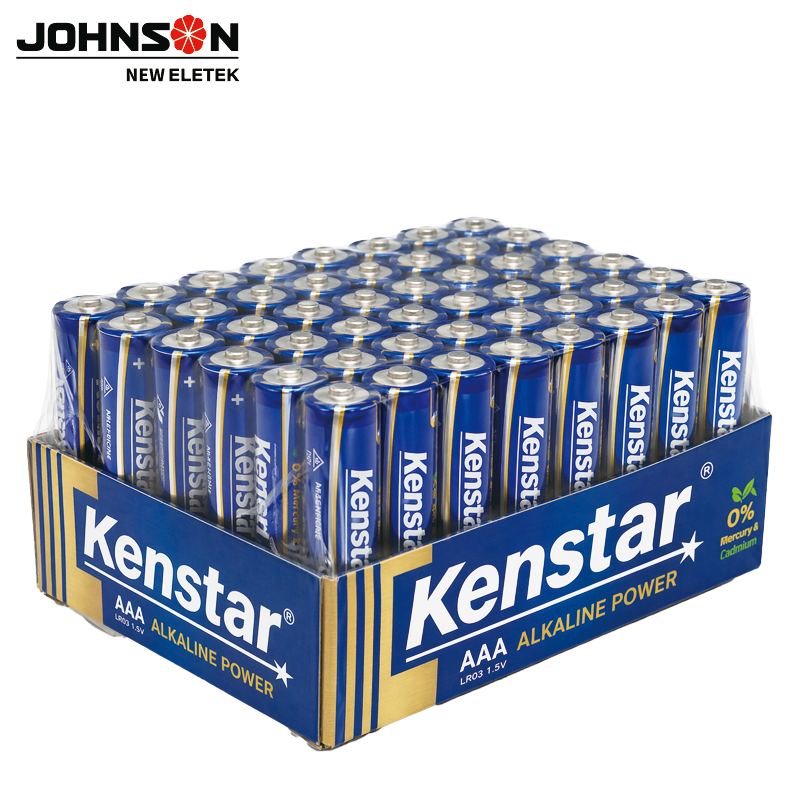
Because a wrapper change is a print change and a print change needs its own proofing and approval cycle, so artwork submitted late does not compress the schedule, it only moves the schedule, so artwork is the first thing to close and the last thing to revise.
MOQ: what moves it, and how to ask
The minimum order quantity on a private label alkaline programme is set by four variables, and they move in different directions.
- Number of colours. Each wrapper colour is a separate print run, so colours multiply both the order quantity per colour and the number of approvals you have to manage.
- Pack format and its tooling. A printed colour box needs its own cutting and print tooling, so changing format is a setup decision, not a printing decision.
- Prepress artwork. Once the artwork set is accepted for a colour and a format, repeating it is the cheapest thing in the programme. Changing it later is the most expensive.
- Cells or finished goods. Buying standard cells in your own printed packaging and buying fully packed, labelled retail units are different orders with different minimums, and the difference should be decided before the artwork is drawn.
The way to ask is to split the question, because a single number answers nothing useful. Ask for the minimum per SKU, per colour and per pack format; ask for the first order separately from a repeat of approved artwork; and ask what happens to the minimum if you consolidate two colours into one run. Because the number that matters is not the headline minimum but the minimum for your exact configuration, so a quotation that only answers the headline question has not answered yours.
Lead time: how the calendar is actually built
Lead time is built from lanes that run in parallel, and the useful question for a supplier is when each lane starts rather than when the whole thing ends.
- Artwork prepress and proofing. Dieline set, colour proof, and your written approval.
- Sample production and approval. A physical sample of the printed pack with the cells in it, checked in your market, not only in the factory.
- Certification and testing. Any test or certification that depends on your own artwork or your brand has to be scheduled separately, and it usually depends on the finished pack rather than on the cell.
- The production run. Cells, printing, packing and assembly in one line, in the order the process actually runs.
- QC and the QC report. Our QC team inspects each batch and issues a report, and that inspection happens before the goods are loaded.
- Packing, marking and loading, including the carton and pallet marks you specified earlier.
The lane that gets forgotten is the third one. A certificate or a test that depends on your brand and your artwork is not on the factory’s production board, so it has to be asked for explicitly and given its own place in the plan. Because certification time runs in parallel with production planning but not with production itself, so a plan that only sequences manufacturing will deliver a container that cannot be sold in the destination market.
On the commercial side, our published terms for this range are EXW, FOB, CIF or DDP, L/C available, a 30% deposit with the balance before shipment, and credit terms negotiable. For a first-time importer, that structure is worth understanding before the quotation rather than after it, because the document set and the inspection window depend on it.
What the factory profile should tell you before you order
You can sanity-check any Chinese battery supplier against published facts before you spend time on samples. Our company profile publishes a 10,000 m² production workshop, 200 skilled workshop staff and eight fully automatic production lines, and states the company was established in 2004 as a manufacturer of all kinds of batteries. It also states its operating principles in unusually plain language: that they are used to telling the truth, that they will not arbitrarily offer prices, that low-quality batteries will not appear in the market, and that they sell batteries and services rather than batteries alone.
Scale figures are worth checking and worth not over-reading. Because a factory with eight lines and 200 people proves that production capacity exists, not that your order will be scheduled into it, so capacity is the entry check and the schedule is the real negotiation.
Frequently asked questions
What is the difference between private label and white label for alkaline batteries?
Private label means your brand and artwork on a product built to a specification you define, including the wrapper print, the pack and the carton marks. White label usually means the same cell in a neutral pack that someone else designed, with your logo applied to that. The practical difference shows up in artwork approval: your own artwork is approved by you, and any later change is a new prepress and a new proof.
How do I decide between a colour box, a blister card and a shrink pack for my first order?
Start from the channel and the handling, not from the artwork. A colour box protects the cells and gives shelf presence in retail, a blister card gives visibility with a printed card, and a shrink pack reduces material and volume but shows less of your print. The cell, the count per pack and the certifications stay the same in all three, so decide the format early, because it drives tooling, artwork and minimum quantity together.
What should I do if the minimum order quantity is higher than my first shipment needs?
Split the question with the supplier instead of accepting or refusing the headline number. Ask for the minimum per SKU, per colour and per pack format, ask whether consolidating colours or formats lowers it, and ask for the minimum on a repeat order of already approved artwork, which is normally a different and smaller commitment than the first run.
Should we make our own tooling and artwork?
Only if the volume and the life of the programme justify it. Artwork is worth owning early, because every later change to a wrapper or a box costs prepress, proofing and approval. Tooling is a bigger commitment and should follow a proven demand for the format rather than precede it.
Can we rely on the factory’s existing certifications for our private label version?
Not automatically. A cell certification is tied to the cell and its construction, while anything that depends on your brand, your artwork or your claims may need its own documentation. That is also why the certification lane has to be scheduled separately: in the EU the battery rules are set by the batteries regulation and the labelling and marking obligations follow the product and the market, not the factory.
How much slack should a first-time importer leave in the schedule?
Plan on the slow lane rather than the average one. Artwork proofing, sample approval and market-specific certification normally run in parallel with production planning but not with production itself, so set a date for each lane, confirm in writing when each one starts, and treat the slowest as the plan rather than as an exception.
About this guide
This guide is compiled from published material: the alkaline battery range with its specifications, certifications and commercial terms, the company profile with its workshop, staffing and production line figures, and the enquiry route on the contact page. It deliberately carries no figures the manufacturer does not publish: minimum order quantities, unit prices and production lead times are confirmed per configuration through the enquiry form, where a reply is stated within 24 hours.
Post time: Oct-29-2026


