
Introduction
For European buyers sourcing alkaline batteries at scale, the lowest unit price rarely tells the full story. Bulk purchasing from an OEM supplier involves more than comparing quotes: it requires checking regulatory compliance, product consistency, logistics reliability, labeling, and the supplier’s ability to support long-term demand across EU markets. A small gap in quality or documentation can quickly turn into customs delays, returns, or costly reputational damage. This article outlines the key factors to review before placing a large order, helping procurement teams reduce risk, protect margins, and choose an alkaline battery OEM partner that can meet European market expectations.
Why look beyond unit price when choosing a battery supplier
As procurement professionals sourcing for European markets, we often encounter the temptation to select an alkaline battery OEM supplier based solely on the lowest cost per unit. When evaluating quotes from various manufacturers, a difference of a few cents per battery can appear as a massive cost savings on a bulk order of millions of units. However, a narrow focus on unit price frequently obscures the total cost of ownership and the hidden liabilities embedded in the supply chain.
We must ask ourselves: why should we control risk before negotiating the final fraction of a cent? The answer lies in the compounding cost of failure. In the highly regulated European market, product failures do not just result in lost inventory; they trigger a cascade of reverse logistics, compliance penalties, and severe brand damage that can easily wipe out any upfront procurement savings.
Compliance, returns, and supply continuity
When importing alkaline batteries into the European Economic Area (EEA), compliance, return rates, and supply continuity form the bedrock of a stable procurement strategy. Non-compliance at European ports or high leakage rates on retail shelves can trigger mandatory product recalls. A return due to leakage does not merely cost the €0.10 or €0.15 paid for the battery; it incurs reverse logistics, administrative penalties, and consumer compensation that can exceed €0.50 per unit.
Supply continuity is equally critical. A supplier offering rock-bottom prices often operates with razor-thin margins, making them vulnerable to raw material price fluctuations (such as zinc and manganese dioxide). If a supplier halts production during peak season because they cannot absorb a 5% increase in raw material costs, the resulting out-of-stock scenario on European retail shelves will cost the brand significantly more than the initial savings.
Lessons from a private-label supermarket case
To illustrate the dangers of the unit-price fallacy, we can look at a recent case involving a prominent European private-label supermarket. The procurement team opted for an unverified supplier offering a 15% discount on AA alkaline batteries compared to the market average. The initial financials looked promising, but the reality of mass production quickly set in.
Within eight months of retail distribution, the supermarket faced a 2.5% defect rate, primarily driven by electrolyte leakage during standard room-temperature storage. The cost of replacing consumer electronics damaged by the leaking batteries, combined with the labor costs of removing the defective batches from 400+ retail locations, wiped out their entire category profit margin for the quarter. This case underscores why risk mitigation must precede price negotiation.
Using a supplier benchmark
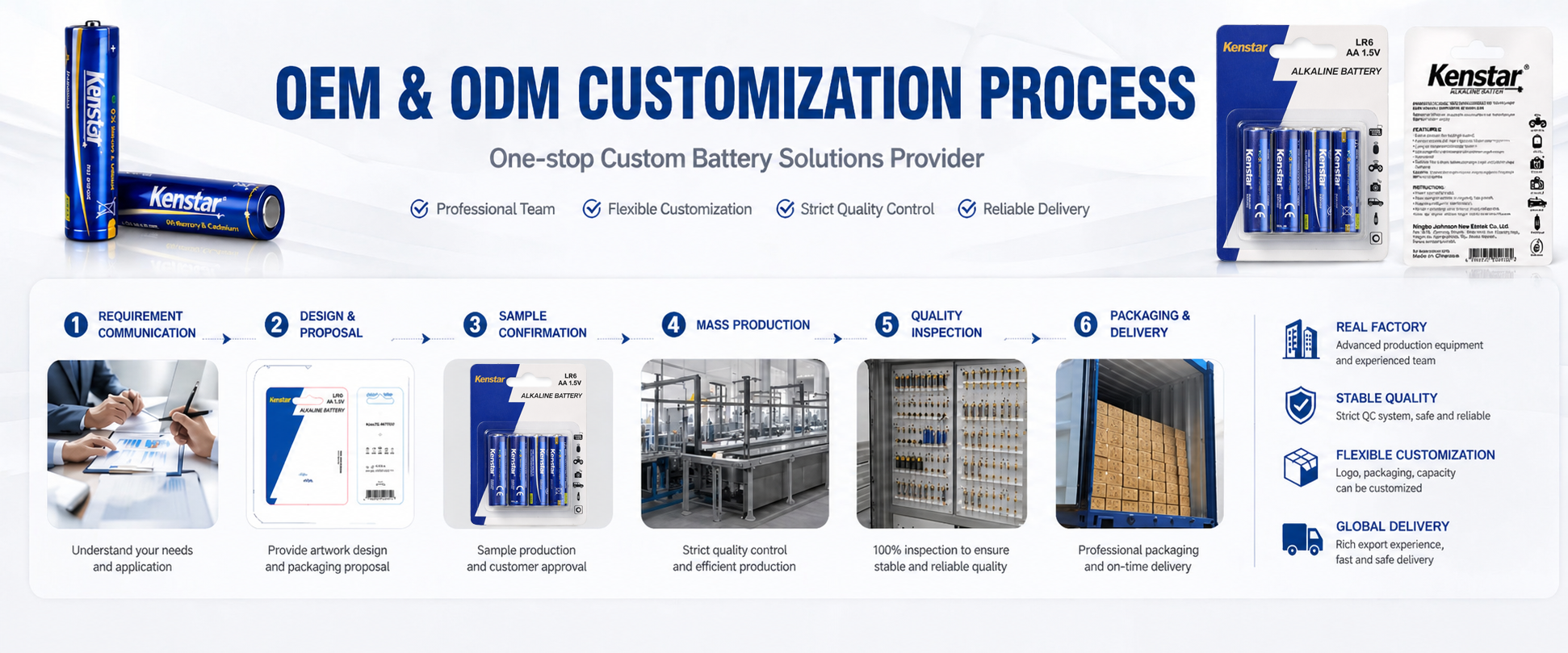
To avoid these pitfalls, European buyers need a reliable baseline for evaluating potential partners. We recommend utilizing a verifiable supplier benchmark to understand what a standard, low-risk procurement framework looks like. For example, we frequently reference Ningbo Johnson New Eletck Co Ltd (and its Kenstar brand) not as the absolute only choice, but as a practical, verifiable reference point for European buyers evaluating alkaline battery OEM suppliers.
As a professional battery manufacturer, they demonstrate the foundational capabilities required for factory-direct B2B collaboration. By examining a supplier with a verified asset scale, dedicated production area, sufficient employee headcount, and automated production lines, buyers can set a baseline for operational stability. Facilities operating under ISO9001 quality management and BSCI social compliance frameworks provide the necessary infrastructure to mitigate procurement risks before the first purchase order is ever signed.
What risks should you assess before placing a bulk order
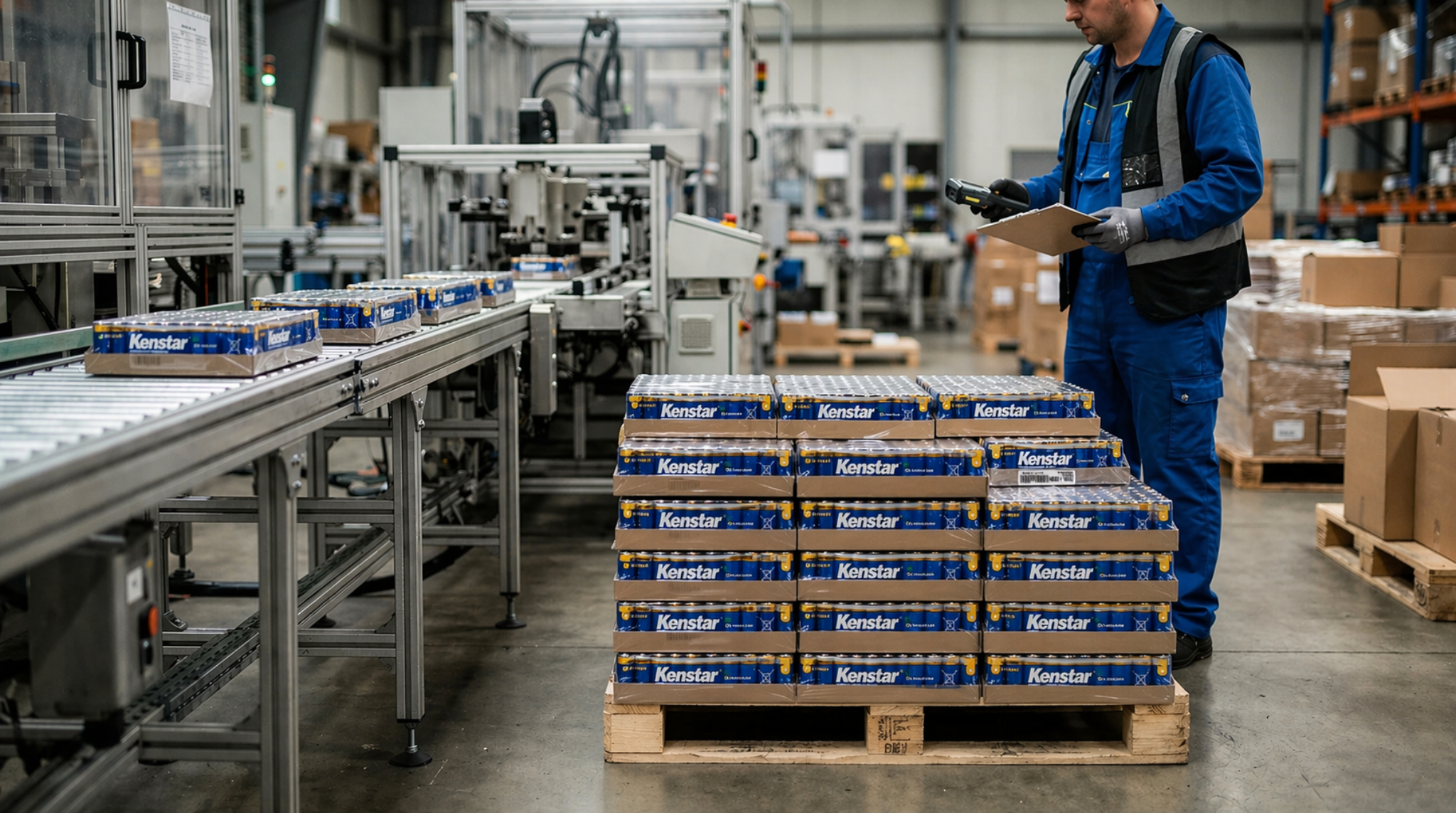
Before issuing a bulk purchase order, we must rigorously evaluate the technical risks associated with alkaline battery mass production. A golden sample that performs perfectly in a laboratory environment does not guarantee that a shipment of two million units will survive the logistical journey from Asia to Europe.
To protect our supply chain, we must transition our focus from generic marketing claims to specific technical indicators, ensuring that the selected battery chemistry matches the intended consumer application and the rigors of international shipping.
Leakage, discharge curve, and shelf life
We are frequently asked why battery capacity cannot be evaluated as a single, static number. The reality is that capacity is highly dependent on the discharge profile. A battery’s milliampere-hour (mAh) rating will fluctuate wildly depending on whether it is subjected to a low-drain continuous load (like a wall clock) or a high-drain intermittent load (like a motorized toy). For instance, testing a AA battery against a 3.9-ohm continuous discharge curve yields a vastly different performance profile than a 10-ohm intermittent test.
Beyond the discharge curve, shelf life and leakage resistance are paramount. Premium alkaline batteries typically advertise a shelf life of 5 to 10 years. However, this longevity is heavily dependent on the internal anti-corrosion formulas and the quality of the nylon sealing rings designed to lower leakage risks. We must assess the supplier’s structural design to ensure it actively helps reduce the probability of electrolyte leakage over extended storage periods.
Batch variation, storage, and transport conditions
Transporting batteries from overseas manufacturing hubs to European distribution centers involves traversing multiple climate zones. A shipping container might experience internal temperatures exceeding 50°C alongside drastic fluctuations in humidity. If batch consistency is poor, the sealants degrade under these thermal stresses, leading to premature leakage before the product even reaches the retail shelf.
We look for suppliers who implement stringent climate testing, such as exposing samples to 45°C and 90% relative humidity for extended periods. Utilizing highly automated assembly lines helps improve batch consistency, ensuring that the critical crimping and sealing processes are applied with uniform pressure across every single unit, thereby lowering the risk of environmentally induced failures.
Key technical and commercial indicators
To standardize our technical risk assessment, we rely on key technical and commercial indicators. These metrics allow us to compare supplier quotes objectively, looking past the marketing fluff to the actual chemical and electrical performance.
| Technical Indicator | Standard Testing Condition | Acceptable Range (AA Alkaline) |
|---|---|---|
| Open-Circuit Voltage (OCV) | 20°C ± 2°C, fresh cell | 1.58V – 1.65V |
| Closed-Circuit Voltage (CCV) | 3.9-ohm load, 0.3 seconds | ≥ 1.45V |
| Short-Circuit Current (SCC) | 20°C ± 2°C, fresh cell | 8.0A – 14.0A |
| High-Temp Leakage Test | 45°C, 90% RH for 30 days | 0 visual leakage |
| Heavy Metal Limits | Inductively Coupled Plasma | Hg < 0.0001%, Cd < 0.001% |
By mandating these specific indicators in the supplier quality agreement, we establish clear thresholds for acceptance and rejection. This quantitative approach removes ambiguity from the quality control process and ensures that both the buyer and the supplier share a unified definition of an acceptable production batch.
Which compliance documents and test standards matter
Entering the European market requires strict adherence to a complex web of environmental and safety directives. A battery that performs exceptionally well is entirely useless if it is impounded by European customs due to missing or fraudulent compliance documentation.
We must ensure that our alkaline battery OEM supplier provides comprehensive, traceable, and up-to-date compliance documentation that satisfies both regulatory bodies and the stringent requirements of major European retail channels.
Reviewing RoHS, REACH, and IEC 60086
The three foundational pillars of European battery compliance are the IEC 60086 standard, the RoHS Directive, and the REACH Regulation. IEC 60086 dictates the physical dimensions, safety parameters, and standardized testing methodologies for primary batteries, ensuring universal compatibility and consumer safety.
Simultaneously, environmental directives are non-negotiable. Alkaline batteries must adhere to strict heavy metal limits. Specifically, they must be formulated to contain less than 0.0001% mercury and less than 0.001% cadmium by weight. Furthermore, the REACH regulation requires continuous monitoring of over 240 Substances of Very High Concern (SVHCs), necessitating suppliers to maintain tight control over their raw material supply chains to ensure no restricted chemicals enter the manufacturing process.
What a practical document pack should include
A critical question arises during compliance audits: how do we ensure a test report corresponds to our specific production batch? Generic, years-old test reports downloaded from a supplier’s website are insufficient for European customs clearance. A practical document pack must provide an unbroken chain of traceability.
The documentation should include a detailed Bill of Materials (BOM), recent material safety data sheets (MSDS), and UN38.3 transport certificates where applicable. More importantly, the date codes and batch identifiers printed on the battery jackets and master cartons must directly cross-reference with the lot numbers listed on the provided chemical analysis reports. This traceability ensures that if a localized issue occurs, we can isolate the specific batch rather than executing a total product recall.
Third-party testing and documentation support
Suppliers who proactively support compliance verification drastically reduce the buyer’s administrative burden. A mature supplier complies with relevant EU requirements by maintaining up-to-date certifications and actively facilitating independent verification.
For example, Kenstar serves as a reliable reference point in this regard. They supply mercury-free and cadmium-free solutions tailored to project requirements and seamlessly provide RoHS and REACH data. Furthermore, they support third-party testing initiatives, readily cooperating with agencies like SGS or TÜV to validate their chemical compliance. This level of transparency in documentation support is exactly what European buyers should mandate when finalizing their procurement contracts.
How do you verify samples, mass production, and delivery consistency
Transitioning from an approved golden sample to full-scale mass production is the phase where many procurement projects falter. A supplier’s ability to handcraft fifty perfect samples in an R&D lab does not equate to the capability of manufacturing five million identical units under tight deadlines.
We must establish rigorous verification protocols for mass production and carefully map out the logistics and financial structures to ensure consistent delivery, especially during high-demand retail seasons.
Sample-to-production quality checks
When auditing a new partner, how do we accurately judge their true delivery capability? We look beyond their stated maximum output and examine their production infrastructure. The integration of highly automated production lines is a critical indicator; automation reduces human error, regulates assembly speed, and helps improve batch consistency across large orders.
To verify this consistency, we recommend implementing strict Acceptable Quality Limit (AQL) inspections prior to shipment. A standard approach for battery procurement is enforcing an AQL of 1.0 for major defects (such as voltage drops or visual dents) and 2.5 for minor defects (such as slight label misalignments). Furthermore, suppliers should facilitate pre-shipment batch inspections, allowing third-party auditors to pull random samples directly from the completed pallets to verify that the mass-produced units match the golden sample’s discharge specifications.
Breaking down total landed cost
Evaluating the financial viability of a bulk order requires breaking down the total landed cost. The ex-works (EXW) or Free on Board (FOB) unit price is merely the starting point. We must account for freight, insurance, import duties (which generally hover around 4.7% for primary cells entering the EU), and the hidden costs of inventory holding.
| Cost Component | Impact on Total Landed Cost | Strategic Consideration |
|---|---|---|
| FOB Unit Price | 60% – 70% | Negotiated based on MOQ (typically 50k – 100k units) |
| Ocean Freight | 15% – 20% | Container optimization (A 20ft container holds ~1.5M AA cells) |
| EU Import Duties | ~4.7% | Accurate HS code classification is mandatory |
| Defect / Return Buffer | 2% – 5% | Lowered by selecting suppliers with high batch consistency |
| Inland Logistics | 5% – 10% | Impacted by packaging weight and pallet configuration |
By analyzing this breakdown, we quickly realize that a supplier offering a unit price €0.02 cheaper but requiring an excessive Minimum Order Quantity (MOQ) that ties up cash flow in warehouse inventory may actually increase the total landed cost over a fiscal year.
Retest and peak-season delivery cases
Delivery consistency is put to the ultimate test during peak retail seasons, such as the Q3 buildup for Q4 holiday sales. During these periods, standard lead times of 30 to 45 days can rapidly stretch to 60 days or more due to raw material shortages or port congestion.
We evaluate a supplier’s robustness by reviewing past retest and peak-season delivery cases. A reliable partner anticipates these bottlenecks by securing raw materials in advance and maintaining transparent communication regarding production schedules. Rather than promising the lowest absolute price, a mature supplier optimizes the cost structure based on specific order conditions and realistic lead times, ensuring that promotional retail end-caps in Europe are never left empty.
How do you finalize supplier selection and launch planning
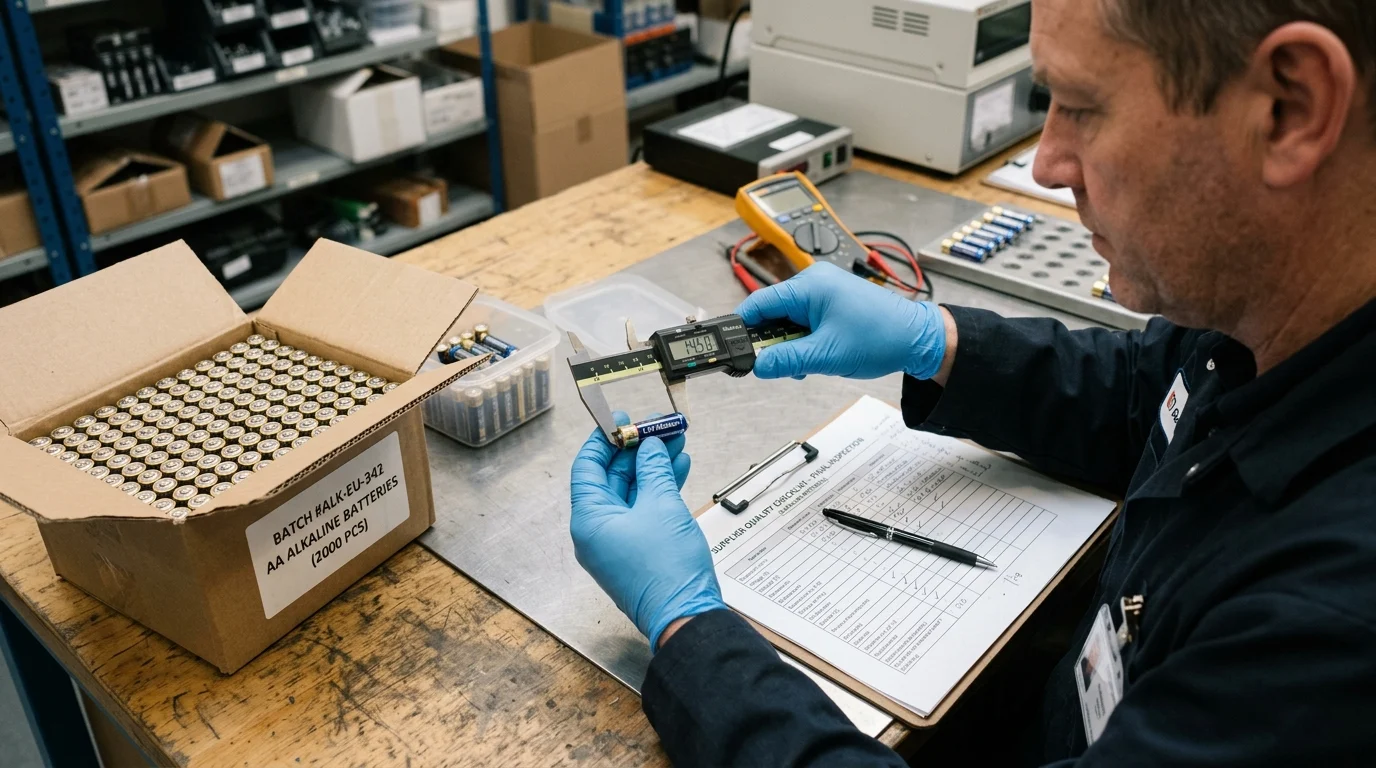
The final stage of bulk purchasing involves preparing the product for the retail shelf. This requires seamless coordination between the procurement team, the marketing department, and the OEM supplier to ensure that the final product meets both commercial branding goals and strict regulatory demands.
Supplier selection is not just about the battery cell itself; it is about the supplier’s ability to execute complex packaging requirements and support the brand’s long-term category growth in the European market.
Packaging and listing readiness
Before a product reaches the retail shelf, what exactly must we confirm during the launch planning phase? The priority is ensuring that private-label packaging complies with regional retail regulations. This includes verifying that mandatory safety warnings, proper disposal symbols (such as the crossed-out wheeled bin), and accurate capacity claims are clearly printed on both the primary battery jacket and the secondary retail packaging.
Packaging format also drastically impacts logistics. Custom packaging choices—such as high-density shrink wrap versus individual blister cards—affect both retail display appeal and shipping volume. While blister packs offer superior visibility on retail pegboards, they can reduce container unit density by up to 40%, thereby increasing the per-unit freight cost. The supplier must be capable of executing these private-label packaging formats flawlessly while providing accurate master carton dimensions for our freight forwarders.
Supplier evaluation criteria
Our final supplier evaluation criteria focus on long-term viability and product breadth. A strategic OEM partner should offer a comprehensive product portfolio that allows for future category expansion. We look for suppliers capable of manufacturing alkaline, carbon-zinc, NiMH, button, and rechargeable batteries under one unified quality management system.
Furthermore, the supplier must demonstrate a willingness to cooperate with private-label document audits. This includes providing the necessary technical data sheets and compliance certificates formatted specifically for our brand’s internal quality assurance databases, ensuring that our customer service teams have the correct information to handle end-user inquiries.
Final compliance and procurement checklist
As we finalize our procurement checklist, we synthesize compliance, technical verification, and packaging readiness into a single cohesive strategy. Utilizing a reference benchmark helps ground this process in reality. Kenstar serves as an excellent reference solution for European buyers assessing alkaline battery suppliers, demonstrating how a professional manufacturer integrates ISO9001 and BSCI standards into daily operations.
By evaluating how they handle private-label packaging files, facilitate batch inspections, and optimize cost structures based on order conditions, buyers can establish a clear standard for their own procurement efforts. Ultimately, by moving beyond the unit-price fallacy and focusing on verifiable capabilities, we can build a resilient, compliant, and highly profitable battery supply chain for the European market.
Key Takeaways
- The most important conclusions and rationale for bulk, alkaline battery OEM supplier Europe
- Specs, compliance, and risk checks worth validating before you commit
- Practical next steps and caveats readers can apply immediately
Frequently Asked Questions
Why isn’t the lowest unit price the best choice for European bulk battery buying?
Because recalls, leakage returns, port delays, and stockouts can cost far more than a small per-unit saving. Compare total landed risk, not just the quote.
What compliance documents should a battery OEM supplier provide for Europe?
Ask for IEC test reports, MSDS, transport documentation, and factory certifications such as ISO9001. Also confirm packaging and labeling meet EEA import requirements before shipment.
How can I reduce leakage risk before placing a large alkaline battery order?
Request mass-production samples, leakage test data, shelf-life data, and batch QC records. Verify performance after storage and shipping simulation, not only from a lab golden sample.
What should I check to confirm supply continuity from an OEM supplier?
Review factory scale, automation level, raw material sourcing stability, monthly capacity, and peak-season delivery history. A stable supplier is less likely to stop production when material costs rise.
How can zscells.com help buyers evaluate an alkaline battery supplier?
ZSCELLS shares practical battery manufacturing and sourcing criteria buyers can use as a benchmark, including quality systems, production capability, and risk-control points relevant to European OEM procurement.
Post time: May-07-2026


